Waltz, Phase I, Waltz Away
Waltz Away is the first half of the common figure Waltz Away and Together. However, Waltz Away can be used on its own, so it’s helpful to learn it separately.
To correctly dance Waltz Away, you need a sense of which direction you’re moving in a room. So, a few words about ‘moving around the room’ are in order.
Round Dance is so-called because dancers move around the floor in a circular (round!) or elliptical formation. The usual flow of Round Dance is counterclockwise, and this counterclockwise direction is called Line of Dance (abbreviated LOD). However, during a dance, figures may temporarily move in many different directions.
Not sure what counterclockwise means? Think of an ‘old-fashioned’ clock with minute and hour hands sweeping out the day—that’s the clockwise direction. Then, counterclockwise is the other direction!
Why all this talk about the direction a dance is moving? Here’s why. If a couple is not facing the direction the dance is moving when ‘Waltz Away’ is cued, then they must adjust smoothly at the beginning of the first beat.
In Waltz Away, dancers move away from one another, so the name ‘Waltz Away’ is appropriate. They typically hold inside hands, while turning outward. At the end of Waltz Away, dancers are in a slight back-to-back position, with inside hands still joined.
Waltz Away—In a Nutshell
Diagram Notation
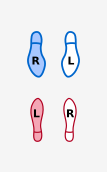
Foot Placement
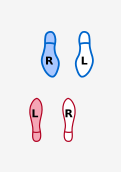
Foot Placement
Feet that are SHADED (blue or red) take weight.
Feet that are NOT SHADED (white interior) are free (without weight; free to move).
Simplified Foot Placement makes diagrams easier to understand for some people. Simplified Foot Placement is an instructional illustration only.
Correct Foot Placement shows foot positions actually used when dancing.
Figure Diagram Notes
Man’s lead foot is his left foot. He typically leads (starts moving) with that foot. Note that ‘lead’ rhymes with ‘reed’ in this context.
Woman’s lead foot is her right foot. She typically leads (starts moving) with that foot.
Common cue: ‘Lead foot free’ means that a dancer’s lead foot is free (without weight; free to move).
Individual Views
Couple Views
Waltz Away is often entered from Butterfly Position. Butterfly Position has the same foot placement as Closed Position. However, in Butterfly Position, arms extend to the sides (like a butterfly), which more easily enables the Waltz Away arm actions.
Notes
- The complete six-beat figure Waltz Away and Together consists of Waltz Away followed by Waltz Together.
- Both Waltz Away and Waltz Together can begin with either free foot—it is determined by the current position and direction.
Ready for More?
Feel comfortable with this lesson? Here’s more!
Curated Resources
Like a bit of history? Enjoy!