Waltz, Phase I, Circle Away And Together
In ‘Circle Away and Together’, man and woman each travel around their own small circle. Dancers first move away from each other along their individual circles—this is the ‘Circle Away’ part of the figure. Then, dancers move towards each other along their individual circles—this is the ‘Together’ part of the figure!
Roundalab Standards (2024) defines ‘Circle Away and Together’ as two half-circles, with a close on Beat 3 and another on Beat 6.
Many dancers, however, dance the figure in a way that is a bit easier, and allows for a bigger (more interesting!) circle. Just progress steadily around the circle for the first five beats, and close (or arrive in another desired position) on Beat 6.
The summary diagrams below compare these two approaches.
Circle Away And Together—In a Nutshell
Diagram Notation
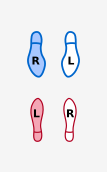
Foot Placement
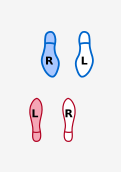
Foot Placement
Feet that are SHADED (blue or red) take weight.
Feet that are NOT SHADED (white interior) are free (without weight; free to move).
Simplified Foot Placement makes diagrams easier to understand for some people. Simplified Foot Placement is an instructional illustration only.
Correct Foot Placement shows foot positions actually used when dancing.
Figure Diagram Notes
Man’s lead foot is his left foot. He typically leads (starts moving) with that foot. Note that ‘lead’ rhymes with ‘reed’ in this context.
Woman’s lead foot is her right foot. She typically leads (starts moving) with that foot.
Common cue: ‘Lead foot free’ means that a dancer’s lead foot is free (without weight; free to move).
Individual Views
Couple Views
Notes
- ‘Circle Away’ and ‘Circle Together’ may be cued separately.
- If the two halves (‘Circle Away’ and ‘Circle Together’) are separated by other figures, then ‘Circle Away’ and ‘Circle Together’ are cued separately.
- On Beats 5 and 6 of Circle Away and Together, feet are adjusted (as needed) to end in the desired position. In this lesson, the Couple Views all show Beat 6 in Open position, whereas the Video Clips use different end positions. The correct end position will be determined by the cues.
Ready for More?
Feel comfortable with this lesson? Here’s more!
Curated Resources
ROUNDALAB (the International Association of Round Dance Teachers) develops and maintains standardized figure definitions, cue terminology, and phase ratings used by most Round Dance teachers and cuers today. These lessons follow current ROUNDALAB standards.
This Roundalab Index of Rounds is an extensive searchable database of Round Dances. You can filter by rhythm, phase, and many other criteria; search for a favorite song title or artist; find published cue sheets; and lots more.
Unfortunately, the index doesn’t provide links to dance videos. But, if you know that a dance has been choreographed (by evidence of a cue sheet), then perhaps you can use your sleuthing skills to find a video! Or (eventually!) use the cue sheet to figure the dance out on your own!
YouTube Dance Demos is an incredible resource for dance videos. It’s what I use for all my Video Clips!