Waltz, Phase I, Balance Back
The just-studied Balance Left and Balance Right give side balances. Balance Forward (previous lesson) and Balance Back (this lesson) move forward and back.
Remember that cues are always directed to the man. The woman needs to adjust accordingly, based on the current position. For example, if a couple is in Closed Position and the cue is ‘Balance Back’, then the man balances back, but the woman balances forward.
The second beat of any balance (left/right/forward/back) is typically done on the ball of the foot (the front part), which gives a gentle body rise.
Balance Back can start with either foot free. Below, it is illustrated with the man’s lead foot free. Regardless of the starting foot, the motions (for the man) are: Forward, Close (on ball of foot), and In Place.
Why is it called a balance? In Beats 2 and 3, the dancer stays essentially in one place, and just transfers weight from foot to foot. This transfer of weight feels like a graceful balancing act.
In this figure, the Roundalab Standards and the way people usually dance it differ slightly:
- Roundalab Standards define the second step as a Close. This places the moving foot in Beat 2 directly beside the supporting foot.
- Most dancers, however, allow the moving foot in Beat 2 to pass slightly beyond the supporting foot. The step is still taken on the ball of the foot.
The summary diagrams below compare these two approaches.
Balance Back—In a Nutshell
Diagram Notation
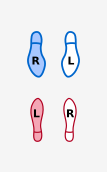
Foot Placement
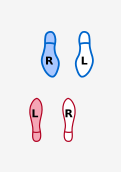
Foot Placement
Feet that are SHADED (blue or red) take weight.
Feet that are NOT SHADED (white interior) are free (without weight; free to move).
Simplified Foot Placement makes diagrams easier to understand for some people. Simplified Foot Placement is an instructional illustration only.
Correct Foot Placement shows foot positions actually used when dancing.
Figure Diagram Notes
Man’s lead foot is his left foot. He typically leads (starts moving) with that foot. Note that ‘lead’ rhymes with ‘reed’ in this context.
Woman’s lead foot is her right foot. She typically leads (starts moving) with that foot.
The foot that is not the lead foot is called the trail foot.
LEAD FEET:
- MAN: left foot
- WOMAN: right foot
TRAIL FEET:
- MAN: right foot
- WOMAN: left foot
Common cue: ‘Lead foot free’ means that a dancer’s lead foot is free (without weight; free to move).
Common cue: ‘Trail foot free’ means that a dancer’s trail foot is free (without weight; free to move).
Individual Views
Couple Views
All Couple Views in this lesson use the Roundalab Standards (2024)
Closed Position has partners facing each other. Therefore, when the Man (Lead) steps back, the Woman (Follow) steps forward. Notice that they use opposite footwork.
Simplified foot placement shows feet directly opposite each other, making diagrams easier to understand for some people. Simplified foot placement is an instructional illustration only.
In actual dance, each dancer’s right foot points between their partner’s feet (to avoid foot collisions).
Simplified is shown by default. If desired, click the Correct button.
Notes
- Balance Forward and Balance Back tend to be used less frequently than Balance Left and Balance Right.
Ready for More?
Feel comfortable with this lesson? Here’s more!
Curated Resources
Kaye West says (and I agree): Let’s get the whole world dancing!
Look around! We’ll be exploring these offerings gradually...